Your watch tells you that you slept 6 hours and 55 minutes, with 1 hour of deep sleep and 1 hour 30 minutes of REM. But what does that actually mean for how you'll feel today? If you live with a chronic condition, the answer can matter a lot. Sleep affects pain, energy, mood, blood sugar and headaches, and the way you sleep often changes before you notice anything else.
Here's a plain-language guide to sleep stages, what your wearable can and can't tell you, and how to connect your nights to your days.
A night in four parts
Sleep isn't one long, even state. Through the night you cycle between stages roughly every 90 minutes, with more deep sleep early in the night and more REM toward the morning.
Light sleep
Light sleep makes up the largest share of the night, typically around half. Your body starts to relax, your heart rate slows, and you're fairly easy to wake. It isn't "wasted" sleep; it's where you spend most of the night and it links the other stages together.
Deep sleep
Deep sleep (also called slow-wave sleep) is the hardest stage to wake from. It's when your body does much of its physical recovery and repair. It's most common in the first part of the night and tends to decrease with age.
REM sleep
REM (rapid eye movement) sleep is when most vivid dreaming happens. It plays a role in memory, learning and emotional processing. REM periods get longer as the night goes on, so cutting your night short often cuts REM the most.
Awake time
Everyone wakes briefly during the night, usually without remembering it. A little awake time is normal. A lot of it, or long stretches awake, can leave you feeling unrested even when your total time in bed looks fine.
Typical ranges for healthy adults
These are the ranges the TakeCare Sleep hub compares your nights with. They're typical, not targets, and they vary from person to person and with age.
- Light sleep: about 45–55% of the night
- Deep sleep: about 13–23%
- REM sleep: about 20–25%
- Awake: under 10%
How accurate is your watch?
Consumer wearables don't measure brain waves the way a sleep lab does. They estimate your stages from movement and heart rate, and some add breathing or temperature. They're generally good at telling asleep from awake and at measuring how long you slept. Individual stage numbers are rougher estimates.
That's why the most useful thing to watch is the trend, not a single night. If your deep sleep is consistently lower on nights after evening drinks, or your awake time climbs during a stressful week, that pattern is meaningful even if the exact minutes aren't perfect.
Why sleep matters so much with chronic conditions
Poor sleep and chronic illness tend to feed each other. Symptoms can disrupt sleep, and short or broken sleep can make many symptoms harder to manage the next day:
- Pain: after a poor night, many people find pain harder to cope with, and pain in turn makes it harder to sleep.
- Migraine: both too little sleep and big changes to your sleep schedule are common migraine triggers.
- Blood sugar: short sleep can make blood sugar harder to manage for people with diabetes and prediabetes.
- Mood and focus: sleep problems are closely linked with depression and anxiety, and with brain fog.
- Energy and fatigue: for conditions like ME/CFS, long COVID and fibromyalgia, unrefreshing sleep is often part of the picture.
Most adults need at least 7 hours of sleep a night. But averages only go so far. The more useful question is: how much sleep, and what kind of night, comes before your better days?
Patterns worth looking for
- Short nights before bad days. Do your worst symptom days tend to follow nights under 6 hours?
- Irregular bedtimes. Do you feel worse after nights when you went to bed much later than usual, even if you slept in?
- Sleep debt. Does a run of slightly short nights catch up with you by the end of the week?
- Afternoon caffeine. Do you sleep less on nights after coffee or tea past 2 PM?
- Alcohol. A drink may help you fall asleep, but it often makes the second half of the night lighter and more broken.
- Late meals and drinks. Do you wake more often after eating or drinking close to bedtime?
How TakeCare connects your nights and your days
Connect your watch through Apple Health or Health Connect and your nights fill in automatically, with stages when your device records them. No watch? Tap "Going to bed" at night, or add a past night with your bedtime, wake time and how well you slept.
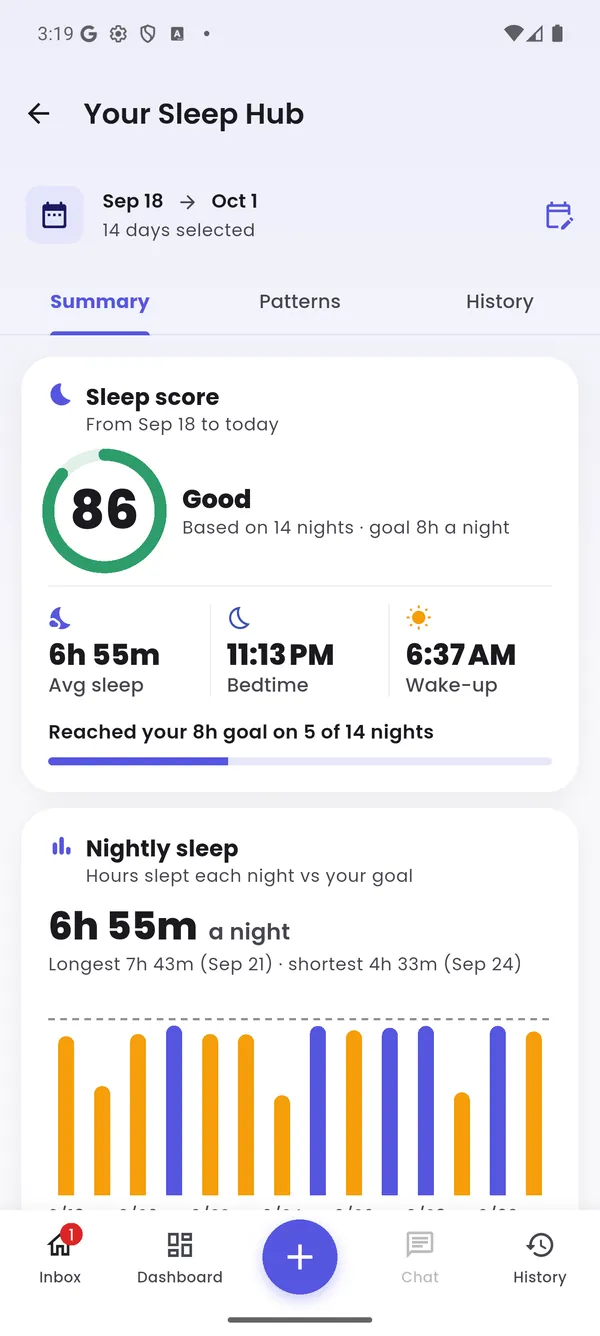
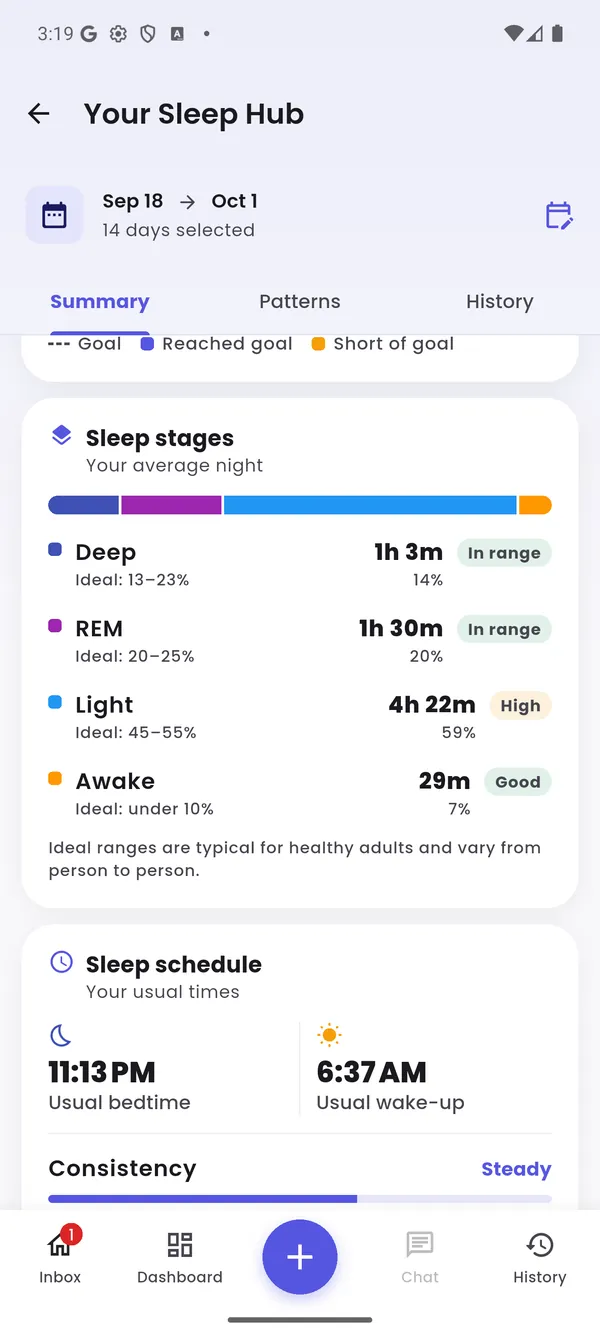
The Sleep hub: your score and nights, then your stages against typical ranges.
The Sleep hub shows:
- A sleep score based on how long you slept, your stages and your timing
- Your stages compared with the typical ranges above
- Your schedule: usual bedtime and wake-up, and how consistent they are
- Best and toughest nights, so you can see what was different
- Patterns that line your sleep up with your symptom ratings: how much sleep comes before your best days, whether a regular bedtime helps, how sleep debt builds over a week, and how time awake relates to how you feel the next day
The Hydration hub adds the drinks side: how long you slept after afternoon caffeine, how alcohol lined up with your sleep, and whether late drinks meant more time awake.
Small changes to try
- Keep a steady schedule: go to bed and get up within about an hour of the same time, weekends included.
- Set a caffeine cutoff: try no caffeine after early afternoon for two weeks and compare.
- Give your last meal and drinks some room: a couple of hours before bed is a good start.
- Keep your room cool, dark and quiet.
- Get daylight and movement early in the day: both help set your body clock.
Change one thing at a time and give it a week or two, so you can see in your data whether it helped.
When to talk to your doctor
Tracking can't diagnose a sleep disorder. Talk to your doctor if:
- You snore loudly, or someone notices you stop breathing or gasp during sleep (signs of sleep apnea)
- You have trouble falling or staying asleep at least three nights a week for several months
- You're very sleepy during the day despite enough time in bed
- You feel an urge to move your legs at night, or act out your dreams
Bring your sleep data with you. A few weeks of nights, alongside your symptoms, is a much better starting point than "I just don't sleep well."